
Centre for Development Economics and Trade
The Centre for Development Economics and Trade (CDET) conducts applied and policy researches focusing on Cambodia’s economy, trade and regional cooperation. We monitor Cambodia’s economic management and performance; provide evidence-based economic policy analysis; and engage in local and regional dialogues to inform policymaking. Our research has a strong link to national policies, particularly the Rectangular Strategy (Phase IV) and the National Strategic Development Plan (2019-23). Specifically, we contribute to two pillars of the NSDP: Economic Diversification, Private Sector and Market Development; and Sustainable and Inclusive Development. Our delivery mechanism includes policy and academic research, capacity building, knowledge dissemination and sharing, and policy influence and outreach. Our research agenda falls within five broad development areas: economic development, focusing on sustainability and inclusion; trade and regional cooperation; private sector development, focusing on small and medium enterprises; employment and employability, with a cross-cutting theme on gender and youth; and data for research and development (D4RD). We have extensive experience on regional cooperation and research projects, working with think tanks and research institutes in ASEAN and the Mekong region. The Greater Mekong Subregion Research Network (GMS-Net) is an example of such collaboration.

Agricultural Trade between China and the Mekong-Lancang Countries: Value Chain Analysis
Lancang-Mekong CooperationThis regional project aims to investigate the agricultural value chain of two selected products exported from Cambodia, Laos, Myanmar, Thailand and Vietnam to China in the hope of exploring, among other things, key actors, thei...

The 2020 Round of Panel Data Collection for Agriculture, Rural Development and Poverty Reduction
Swedish International Development Cooperation Agency | The World Bank | Saitama UniversityCDRI has collected and maintained a panel data of households in rural Cambodia. The work started in 1996-97 when CDRI conducted a benchmark survey of three villages—Prek Khmeng, Babaong and Trapeang Prey. Data collection has been...
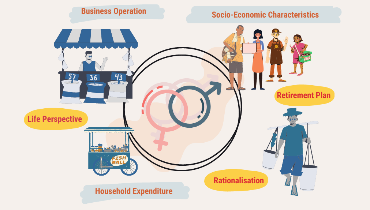
Street Vendors, Youth Employment and Poverty Reduction
Swedish International Development Cooperation AgencyThe purpose of the project is to examine the portfolio of street vendors in nine districts in Phnom Penh. The survey looks at their education, economic activities, income and expenses, and their life satisfaction. There are two p...
There is no data list!

The Emergence of Training Programmes for the Garment Industry: Analysing the Cases of Bangladesh, Cambodia and Sri Lanka from a Historical‐Institution...
This study analyses industry‐specific training programmes catering to the garment industry in Bangladesh, Cambodia and Sri Lanka. Employing a historical‐institutionalist perspective and using mainly qualitative data, it focuses on programmes that are considered particularly relevant by the industry and discuss their characteristics as well as factors that have had an impact on their developme...
Five Priorities for a Green and Inclusive Economic Transformation in Cambodia
During the First PAGE National Steering Committee in Cambodia, PAGE also presented a summary brief outlining five priorities that serves as a roadmap for policymakers and stakeholders to identify the obstacles and opportunities for fostering a green economic transition in Cambodia: Unlocking private and public finance More evidence on different growth pathways Integrating circular economy pri...
Changing Effects of Birth Order on Education Over Time: Evidence from Cambodia
Despite the vast literature on birth-order effects in developing countries, there has been little research on their long-term changes. This study uses three population censuses of Cambodia to investigate how birth order affects educational attainments and how its effects changed over time. We estimate regressions with family fixed effects and cohort fixed effects, and present four findings. First,...
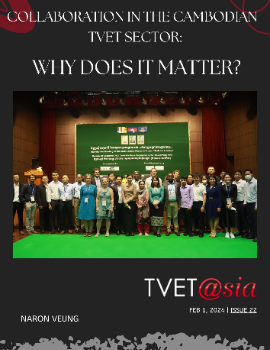
Collaboration in the Cambodian TVET sector: Why does it matter?
The Royal Government of Cambodia (RGC) has promoted collaboration between TVET institutions and the private sector for better skills provision. However, there is still scepticism about collaboration between both parties. This article employs qualitative data to investigate different forms and degrees of collaboration between training providers and companies. It also examines the challenges within...

How the Pandemic Affected the People Who Make Our Clothes
The garment industry in developing countries suffered huge disruptions during and after the COVID-19 pandemic, with economic and social consequences that continue today. In addition to the direct effect of lockdowns, which decreased exports, the industry was severely impacted by its reliance on global imports of fabrics, raw materials and accessories. Although recovery is well underway, some busin...
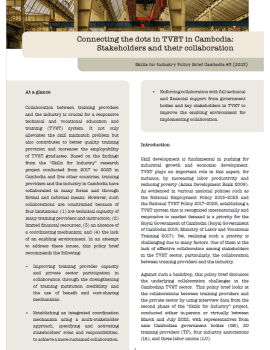
Connecting the Dots in TVET in Cambodia: Stakeholders and their Collaboration
Collaboration between training providers and the industry is crucial for a responsive technical and vocational education and training (TVET) system. It not only alleviates the skill mismatch problem but also contributes to better quality training provision and increases the employability of TVET graduates. Based on the findings from the “Skills for Industry” research project conducted from 2017 to...
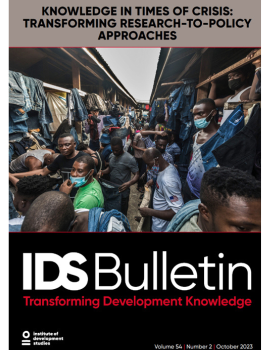
Lessons Learned from Mobilising Research for Impact During the Covid-19 Pandemic
During the Covid-19 pandemic, research organisations have strived to be resilient. This means navigating through the technical, operational, and political challenges to achieving successful research implementation. Particularly for local policy research thinktanks, the pandemic has made these challenges even more difficult to address. From the experience of the Cambodia Development Resource Instit...
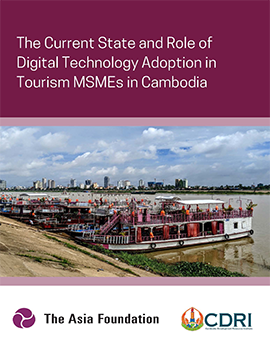
The Current State and Role of Digital Technology Adoption in Tourism MSMEs in Cambodia
The majority of businesses in Cambodia are micro, small, and medium-sized enterprises (MSMEs), which account for 99.9 percent of all businesses and a sizable portion of employment in the private sector. The adoption of digital technology (DT) among Cambodian MSMEs is still uneven and relatively low, despite the fact that it has become an essential component of successful business operations. T...

Evaluating the Role of Digital Technology in Boosting MSME Productivity in Cambodia's Tourism Sector
This research examines the impact of digital technologies on the productivity of Micro, Small and Medium Enterprises in Cambodia's tourism sector. Drawing from extensive survey data, the study confirms that higher DT investments correlate with increased productivity. Notably, MSMEs at the intermediate level of DT integration experience a marked 16 percent productivity increase compared to basic DT...
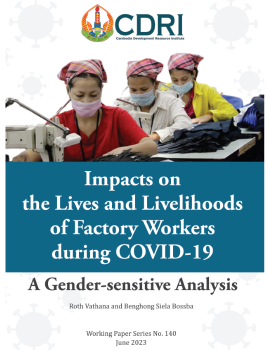
Impact on the Lives and Livelihoods of Factory Workers during COVID-19
This study examines the gendered impacts of COVID-19 on Cambodia’s garment, textile, and footwear (GTF) sector, which employs around 800,000 workers—80 percent of whom are women. Using data from a phone survey of 2,000 workers conducted in mid-2021, the study explores changes in earnings, consumption, remittances, mental health, domestic responsibilities, and coping strategies. Findings reveal an...

Meeting with HE. Chheang Vanarith, Director General of Policy, MEF
Tuesday, 13 October 2020, from 15.00, CDRI Executive Director (Pech Sokhem), Director of Development Economics and Trade (Roth Vathana), and Senior External Relation Officer (Sen Sina) met with HE. Chheang Vanarith, Director General of Policy, MEF, and his senior officials and researchers. Both sides explore a collaborative policy and applied research on food and water nexus, tourism value chain analysis, and social study. The collaborations are...