
20 Years of FDI in Cambodia: Towards Upper Middle-Income Status and Beyond
Although Cambodia has a strong ambition to become an upper middle-income nation by 2030 and a high income by 2050, it faces various challenges in achieving these goals. This study investigates Cambodia’s progress and potential in this regard by analysing its position and trajectory relative to Greenfield Foreign Direct Investment (FDI) inflows...
Barriers to Nutritious Food Production and Consumption: Insights from Two Case Studies
This study investigates the barriers to nutritious food production and consumption in Cambodia’s Tonle Sap Lake floodplain and Mekong Delta, focusing on two case study sites: Boeung Ream Community Fish Refuge in Kampong Thom and Ta Soung Irrigation Scheme in Takeo. Using qualitative methods, including key informant interviews and focus group discus...
Expertise and Immigrant Status: A Bourdieuisan Analysis of How Citizen-led Aid Organisations Provide Health Care Transnationally
The transnational mobility of people, information, and resources is critical to the success of nonprofit international development projects. Ensuring effective transnational flows arguably takes on greater salience for grassroots international nongovernmental organisations (GINGOs), as these organisations and their leaders are unlikely to have a fu...

Negotiating Family and Personal Aspirations: Four Young Cambodian Women Reflecting on Choosing a Major
This qualitative study explores how four young Cambodian women navigated the decision-making process of choosing a university major, focusing on the influence of parental guidance and familial expectations. Drawing on in-depth interviews conducted as part of a broader anthropological dissertation, the paper examines how these women—Kravann, Samedy,...
The Reversal of Gender Gap in Learning: Why Boys Are Falling Behind in Upper Secondary Schools
This study investigates the reversal of the gender gap in academic performance in Cambodia’s upper secondary schools, where female students now consistently outperform their male peers. Employing a convergent parallel mixed-methods design, the research combines qualitative interviews and focus group discussions with quantitative surveys across 23 s...

Profitability and Technical Efficiency of Chilli Farms in Cambodia
This study investigates the profitability and technical efficiency of chilli farming in Cambodia using data from 542 households and 719 plots across six provinces. Employing a revenue-cost framework and stochastic frontier analysis, the research evaluates yields, input costs, and production efficiency. Bird’s eye and lady’s finger chillies are the...
Assessing Technology Readiness of Students and Teachers in Cambodian Higher Education during COVID-19
This study examines the technology readiness of students and teachers in Cambodian higher education institutions (HEIs) during the COVID-19 pandemic, which forced a rapid shift to online learning. Using survey data from 370 teachers and 1,338 students across 22 HEIs, the study applies the Technology Readiness Index (TRI 2.0) to assess readiness lev...

The Political Economy of Land-Water Resource Governance in the Context of Food Security in Cambodia
This study explores the political economy of land and water resource governance in Cambodia’s Tonle Sap floodplains, a region vital to national food security and rural livelihoods. Through desk research and stakeholder interviews, the report examines how governance structures, institutional frameworks, and actor dynamics shape resource management o...
Gender Gap Reversal in Learning and Gender-Responsive Teaching in Cambodia
This study investigates the emerging reversal of gender gaps in Cambodian education, where girls now outperform boys in enrolment and learning outcomes at primary and lower secondary levels. Drawing on quantitative data from SEA-PLM and PISA-D assessments and qualitative insights from key informant interviews, the research explores national policie...
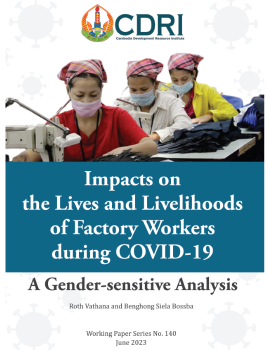
Impact on the Lives and Livelihoods of Factory Workers during COVID-19
This study examines the gendered impacts of COVID-19 on Cambodia’s garment, textile, and footwear (GTF) sector, which employs around 800,000 workers—80 percent of whom are women. Using data from a phone survey of 2,000 workers conducted in mid-2021, the study explores changes in earnings, consumption, remittances, mental health, domestic responsibi...