
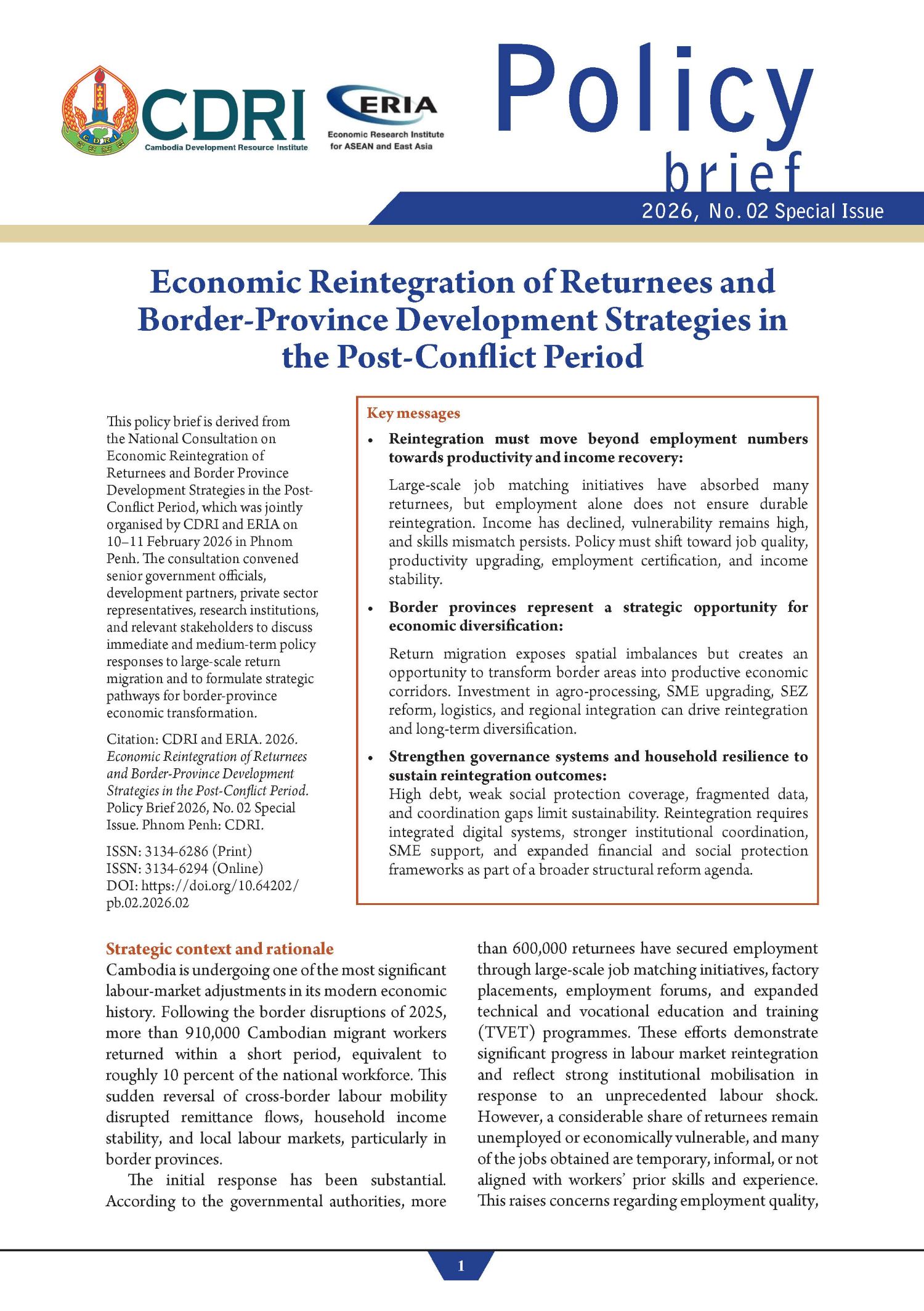
Economic Reintegration of Returnees and Border-Province Development Strategies in the Post-Conflict Period
Keyword: Economic reintegration, employment, return migration, social protection, border provinces
Khmer PDF (21)
Abstract/Summary
- Reintegration must move beyond
employment numbers towards productivity and income recovery:
Large-scale job matching initiatives have absorbed many returnees, but employment alone does not ensure durable reintegration. Income has declined, vulnerability remains high, and skills mismatch persists. Policy must shift toward job quality, productivity upgrading, employment certification, and income stability. - Border provinces represent a
strategic opportunity for economic diversification:
Return migration exposes spatial imbalances but creates an opportunity to transform border areas into productive economic corridors. Investment in agro-processing, SME upgrading, SEZ reform, logistics, and regional integration can drive reintegration and long-term diversification. - Strengthen governance systems
and household resilience to sustain reintegration outcomes:
High debt, weak social protection coverage, fragmented data, and coordination gaps limit sustainability. Reintegration requires integrated digital systems, stronger institutional coordination, SME support, and expanded financial and social protection frameworks as part of a broader structural reform agenda.
Related Publications
The Role of Digital Platforms and Cross-Border Trade in Cambodian Firm...
30-Sep-2026
Digital platforms are reshaping how firms access markets, manage transactions and participate in international trade. In...
The Economic Impact on Cambodia of International Energy-Market Disrupt...
28-Jul-2026
We use GTAP-FIN, a dynamic global computable general equilibrium model, to estimate the consequences for Cambodia of en...
Determinants of Informal Borrowing: Evidence from Households in 11 Rur...
12-Jun-2026
Informal borrowing remains an important source of financing for rural Cambodian households, exposing them to exploitativ...