
Assessing Impacts of New Irrigation System Among Cambodian Farmers: A Case of Study of Dautri Dam

Project Description
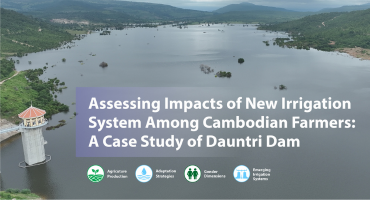
The study examines the impacts of the Daun Tri Dam irrigation system in Battambang Province, focusing on how water distribution and access shape agricultural production and rural livelihoods. It analyzes variations in irrigation connectivity across 11 communes and how these differences influence farming practices, resource use, and resilience to climate risks such as drought and flooding. By comparing households with no access, partial access, and early access to irrigation water, the study provides a nuanced understanding of the emerging irrigation system’s socio-economic and gendered effects.

Project Objective
The study aims to assess how differences in irrigation access affect cropping intensity, input use, and farmers’ adaptation strategies, including migration decisions. It also seeks to examine the relationship between water availability and women’s decision-making power and labor burden within agricultural households. Ultimately, the research intends to generate evidence to inform more equitable and effective irrigation policies and water management systems in Cambodia.

Start Date : 01-Jan-2026
End Date : 31-Dec-2026

Donors


Other Projects

Cambodia Gender and Inclusive Development Analysis...

This study aims to fill this gap in research by conducting a Gender and Inclusive Development Analysis (GIDA) combining qualitative and quan...


Cambodia's Agri-Food Trade: Structure, Challenges,...

From the early 1990s, Cambodia’s agricultural food trade was seen as exports of raw materials and unprocessed primary commodities to neighbo...


Network for Agriculture and Rural Development Thin...

The Network of Agriculture and Rural Development Think-tanks (NARDT) project is designed to form a consortium with flexible cooperation mech...


On-farm Food Safety in Horticulture in Cambodia: T...

Despite being an agrarian economy, Cambodia imported vegetables approximately 70 percent of the total domestic consumption because the com...